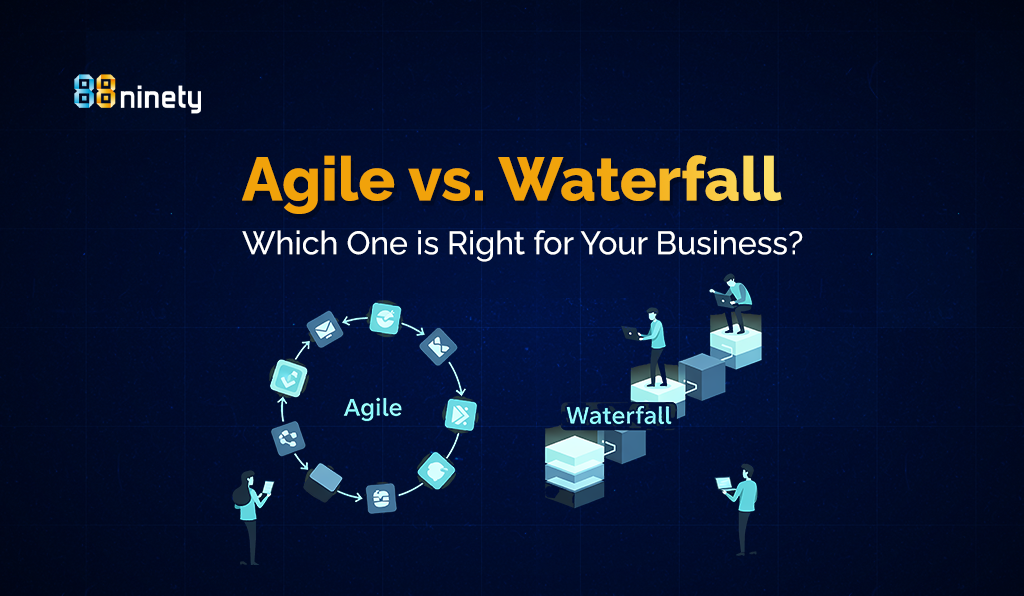
When it comes to managing projects, two big names always pop up Agile and Waterfall. These are the two main ways businesses handle projects, especially in tech and software development. But which one is the best for your business? That’s what we’re going to break down in this article.
If you’ve ever felt stuck choosing between these two, don’t worry you’re not alone. Let’s go step by step and compare Agile and Waterfall in a way that makes sense, without all the complicated jargon
What is the Waterfall Methodology?
Waterfall is the traditional way of doing things. It’s called “Waterfall” because the project moves in one direction, just like water flowing down a waterfall. Each step is completed before moving to the next. It follows a clear structure:
- Requirements: Everything is planned in detail before starting.
- Design: The team creates a blueprint of how the final product will look.
- Implementation: The actual work begins based on the plan.
- Testing: The project is tested to fix any problems.
- Deployment: The final product is released.
- Maintenance: Any future fixes or updates are handled.
This method is great for projects with a fixed budget and a clear end goal. It works best when there’s no room for changes along the way. Think of construction projects once a building is halfway built, you can’t just change the foundation!
Pros of Waterfall
Cons of Waterfall
What is the Agile Methodology?
Agile is the opposite of Waterfall. Instead of a strict plan, Agile is flexible and allows for changes along the way. It breaks a project into smaller parts called sprints. Each sprint is a short cycle (usually 2-4 weeks) where the team works on a piece of the project, tests it, and gets feedback.
Here’s how Agile works:
- Plan: The team decides what to work on first.
- Develop: They build a small part of the project.
- Test: They check if it works.
- Review: The team and clients give feedback.
- Repeat: The process starts again until the project is complete.
This method is used a lot in software development, startups, and creative industries where things change quickly.
Pros of Agile
Pros of Agile
Agile vs. Waterfall: A Side-by-Side Comparison
|
Feature |
Waterfall |
Agile |
|
Flexibility |
Low (follows a strict plan) |
High (adapts to changes) |
|
Project Size |
Best for large, stable projects |
Best for evolving, fast-moving projects |
|
Speed |
Slower (everything is done in one go) |
Faster (work is done in small parts) |
|
Client Involvement |
Low (clients see the final product) |
High (clients give feedback throughout) |
|
Risk of Failure |
Higher (problems are found late) |
Lower (problems are fixed early) |
Which One Should You Choose?
So, should you go with Agile or Waterfall? Here’s a simple way to decide:
- Choose Waterfall if your project is big, stable, and has a clear goal with minimal changes.
- Choose Agile if you need flexibility, fast changes, and regular feedback.
Many businesses now use a mix of both. This is called the Hybrid Approach. It takes the best parts of each method and adapts them based on the project’s needs.
Final Thoughts
Both Agile and Waterfall have their place in the business world. The key is understanding what works best for your project and team. Agile is great for flexibility and fast results, while Waterfall provides structure and stability.
At 88ninety, we understand that no two projects are the same. That’s why we work with businesses to find the right approach for their needs. Whether you’re building a brand new product or refining an existing one, we can help you choose the right path.